

Fascinating 9 State DOT Study – Geosynthetics in Subgrade Stabilization
Geosynthetics in Subgrade Stabilization: Insights from a 9 State DOT Study
Introduction
A groundbreaking multi-state DOT study, sponsored by nine State Departments of Transportation and conducted at Montana State University’s TRANSCEND facility, has provided critical insights into the performance of geosynthetics for subgrade stabilization. This first-of-its-kind, full-scale, side-by-side testing compared 12 different geosynthetics to determine their effectiveness in supporting heavy traffic over weak subgrades. The DOT study, detailed in a 331-page report by the Montana Department of Transportation (view full report), explored which geosynthetics—geogrids or geotextiles—performed best and identified key material properties driving their success. This blog post summarizes the study’s findings, offering valuable takeaways for engineers, contractors, and transportation professionals.
The Test Setup: A Real-World Simulation
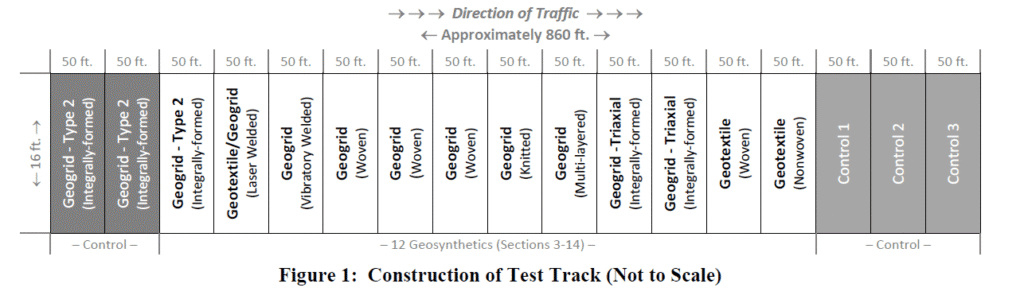
The DOT study constructed 17 full-scale test sections, each 50 feet long, at the Western Transportation Institute’s research facility. Fourteen sections included geosynthetic reinforcement—nine geogrids, two geotextiles, and one geogrid/geotextile composite, sourced from seven manufacturers—while three served as unreinforced controls. The subgrade was prepared with an average strength of 1.79 CBR (California Bearing Ratio), and the base course averaged 10.9 inches thick, except in two control sections.
A fully loaded three-axle dump truck, weighing 45,420 pounds with 90 psi tire pressure, trafficked the sections at 5 mph for 740 passes. Rutting, geosynthetic displacement, strain, and subgrade pore-water pressure were monitored until the rut depth reached 3 inches, defined as failure. This rigorous setup mimicked real-world conditions, providing robust data on geosynthetic performance.
Key Findings: Performance Rankings and Insights
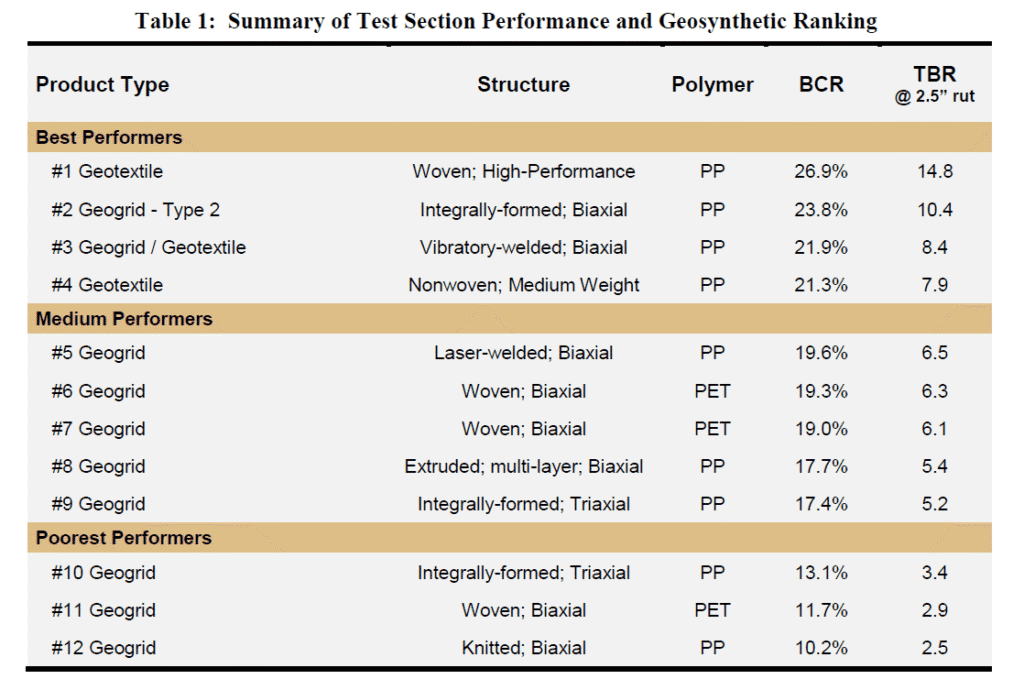
The DOT study evaluated geosynthetic performance using two metrics: Base Course Reduction (BCR) and Traffic Benefit Ratio (TBR). BCR measures the percentage reduction in base course thickness for reinforced sections compared to unreinforced ones with equivalent performance. TBR quantifies the ratio of truck passes a reinforced section could withstand compared to an unreinforced section at a 2.5-inch rut depth.
Top Performers
- #1 Woven High-Performance Geotextile (PP): Achieved the highest BCR (26.9%), equivalent to a 4-inch reduction in gravel, and a TBR of 14.8, outperforming all geogrids.
- #2 Biaxial Geogrid (Integrally-formed, PP): Recorded a BCR of 23.8% and TBR of 10.4.
- #3 Geogrid/Geotextile Composite (Vibratory-welded, PP): Posted a BCR of 21.9% and TBR of 8.4.
- #4 Nonwoven Geotextile (Medium Weight, PP): Despite lower tensile strength, it outperformed most geogrids with a BCR of 21.3% and TBR of 7.9.
Medium and Poorest Performers
- Medium Performers: Included laser-welded and woven biaxial geogrids (BCRs of 17.7–19.6%, TBRs of 5.2–6.5).
- Poorest Performers: Triaxial geogrids and a knitted biaxial geogrid ranked lowest, with BCRs as low as 10.2% and TBRs as low as 2.5. Forensic excavations revealed ruptured ribs in triaxial geogrids under high rutting.
Material Properties Driving Performance
The DOT study found that geogrid performance correlated strongly with junction strength, tensile member stiffness (measured by Aperture Stability Modulus), and wide-width tensile strength in the cross-machine direction. For geotextiles, surface friction and tensile strength likely played significant roles, though further research is needed to pinpoint their contributions. These properties’ impact varied with base course thickness and anticipated rut depth.
Surprising Results: Geotextiles Outshine Geogrids
Contrary to expectations, a woven high-performance geotextile outperformed all geogrids, achieving the greatest base course reduction and supporting the most truck passes. Even a nonwoven geotextile, with lower tensile strength, surpassed most geogrids, ranking fourth overall. On average, geosynthetics enabled six to seven times more traffic passes than unreinforced sections at a 2.5-inch rut depth, highlighting their value in subgrade stabilization.
Implications for Road Construction
This DOT study underscores the potential of geosynthetics to enhance road durability and reduce construction costs by minimizing base course material. Woven and nonwoven geotextiles, often overlooked in favor of geogrids, proved highly effective, suggesting engineers should consider them for projects on weak subgrades. However, selecting the right geosynthetic requires understanding specific material properties and project conditions, such as anticipated traffic loads and subgrade strength.
Conclusion
The multi-state DOT study offers a comprehensive look at geosynthetic performance, revealing that geotextiles can outperform geogrids in subgrade stabilization and identifying key material properties that drive success. These findings can guide transportation agencies and contractors in optimizing road construction, improving longevity, and reducing costs. For the full 331-page report, visit the Montana Department of Transportation’s research page.
References: Christopher et al. (2009), Cuelho et al. (2008, 2009), Fannin & Sigurdsson (1996), Holtz et al. (2008), and others cited in the original report linked below.
View Full PDF Synapsis: https://carthagemills.com/wp-content/uploads/2025/06/State-DOT-Funded-Geo-Subgrade-Synopsis.pdf